
Do you remember being given timed multiplication tests? We’d have 5 or 10 minutes to get through as many of the multiplication problems on the worksheet as possible. Some people enjoyed those tests, others not so much.
Whether or not it’s assessed by timed tests, having multiplication facts memorized makes learning more advanced math skills more approachable and less stressful.
Reducing fractions, finding common denominators, factoring quadratics, and solving multi-step word problems can all become long, tedious, and exhausting chores if a student has to stop and try to reason out the answer to 7 x 8 in the middle of the problem. When students have to put in hard work just to figure out the multiplication, they might feel like they’ve already spent all the energy they have available for math and become overwhelmed by the prospect of needing to do more to solve the problem. Having the times tables memorized can help alleviate this stress.
Just starting multiplication? Stick with it!
If your elementary child is just starting to learn multiplication, please encourage them to stick with it and practice regularly. They should eventually memorize their times tables up to at least 10 x 10, but preferably up to 12 x 12. Please see below for tips and resources to help with memorization.
Is your older student struggling through their homework? Make sure they have their times tables down!
If your upper elementary, middle school, or even high school student gets exhausted and overwhelmed completing their homework assignments, I recommend doing a quick check to see if they have their multiplication tables down. Ask them a few facts up to 10 x 10. Just say, “What’s 2 times 4?” Start with the easier, lower numbers and progress upwards. If at any time your child is unable to answer 2 questions in a row, go back to an easier fact and try to find out which times tables they have mastered (1-times, 2-times, 3-times, etc.), and which they need to work on.
Sometimes the older kids will be able to tell you which multiplication facts they know and which they don’t. They usually just need someone to hold them accountable and help keep them motivated to work at it. That’s where you come in!
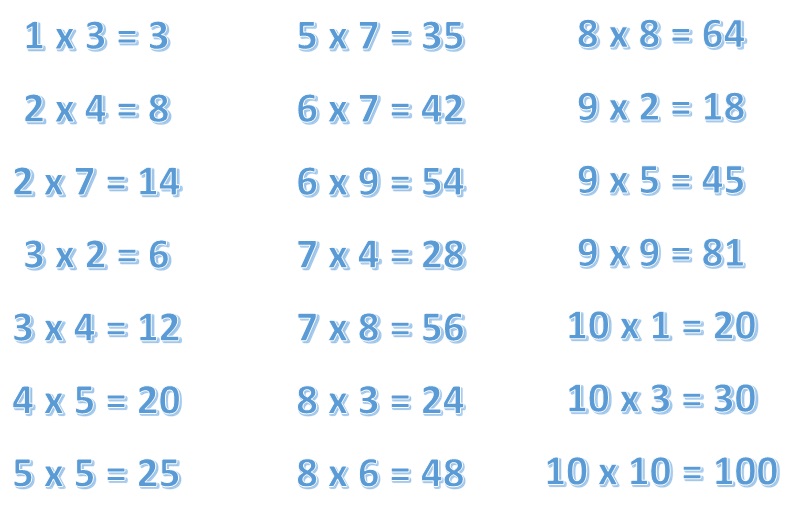
Keep It Short and Sweet!
I recommend spending just a few minutes twice a day, every day, working on memorizing math facts. Five minutes in the morning and five minutes in the late afternoon or evening of low stress math fact review will help keep it fresh and make memorization easier.
Review the facts your child has down and only add in a few unmastered facts at a time. Let them feel accomplished and work at increasing their speed for a few days before adding new facts.
For example, suppose your child has their 1-times, 2-times, and 3-times memorized, but struggles when they get to 4 x 6. Have them review the facts they have memorized so they improve their speed, and add in 4 x 6, 4x 7, and 4 x 8. When they answer all of those facts correctly most of the time for two or three days in a row, then add in 4 x 9 and 4 x 10.
Mix it up!
I recommend using a variety of tools so that the regular review stays a little varied and interesting. Choose the tools that are the least stressful for your child.
Verbal review is a simple way to squeeze in multiplication practice without disrupting much of the day. Try it in the car on the way to school, while brushing hair, or while walking the dog. During review time, start off by asking your child the answer to several multiplication facts that your student knows fairly well. Then add in two or three that they struggle with, reviewing each of them several times in a row. Next, rotate between these difficult facts a few times. End by reviewing several facts that they recently mastered so they are both starting and ending on a positive note.
Flash cards make it easy to quickly review specific multiplication facts. Find an app, buy pre-made physical cards, or make your own. Try keeping 3 groups of flash cards:
Easy – facts that your child answers quickly;
Medium – facts that your child knows, but still takes a little time thinking about;
Hard – facts that your child does not usually answer correctly.
During flash card review, you’ll want most of the cards to be from the medium group, with just a few of the easy and hard facts thrown in. Celebrate when a multiplication fact moves from the hard group to the medium group. Celebrate the most when a fact moves to the easy group.
Print worksheets with the specific facts your child is working on and have them do just a few problems at a time until they become easy. As your child becomes more proficient, have them do an entire sheet as fast as they can. Time them and encourage them to improve their time each week.
Print a multiplication chart to hang on the refrigerator or in your child’s room to use as a tool until they have their facts memorized. Seeing the chart regularly will help them visualize the facts and for some children this can help with the memorization.
There are many online games available to help students work on their math skills. Find one that your child enjoys, or at least tolerates, and encourage them to play the game regularly.
Below are some of my favorite resources:
- Flash Cards: Math Flash Cards Practice Math Facts (math-drills.com) – Here you can enter the numbers and operation your child is working on. You can save your child’s score and time to help monitor improvement.
- Worksheets: Multiplication Facts Worksheets (math-drills.com) – Scroll down to find a worksheet that matches the facts your child is currently working on.
- Multiplication Charts: Multiplication Tables to 144 — One per page (D) (math-drills.com) – These charts are great reference tools. I recommend having your student color in the square numbers down the diagonal (1×1=1, 2×2=4, 3×3=9, etc).
- Games: Multiplication Mine • ABCya!; Clear It Multiplication • ABCya!; Math Lines: Multiplication • ABCya! – These games encourage you to be fast with your facts!
Memorizing is hard work, but it will make their math life so much easier in the long run!
 Math Talk 4 Parents
Leave a comment